

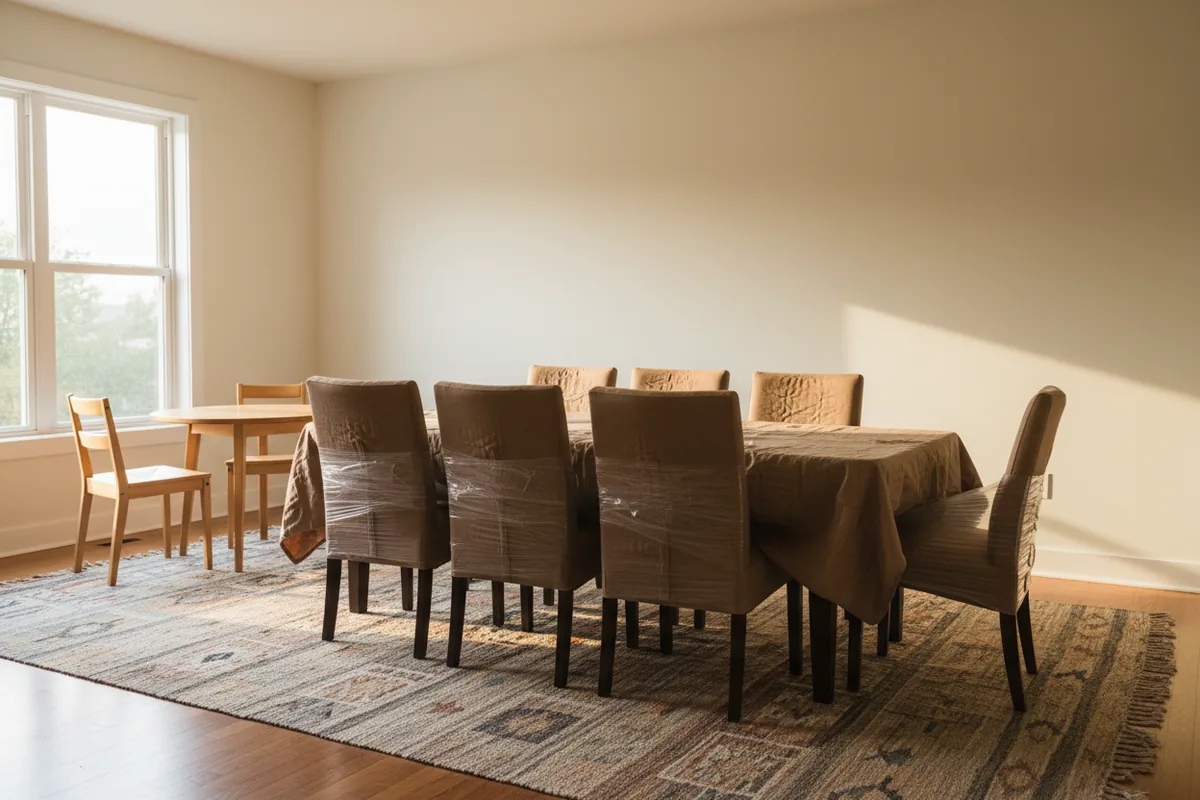
You may be standing in a living room full of furniture that fit a family home for decades, with a parent, a spouse or yourself about to move into an apartment, a retirement community or assisted living somewhere in California. The sofa, the dining set and the bedroom pieces all carry history. The practical answer starts with two things: what the new space can hold, and what the person will use there every day.
Rightsizing furniture for a move to a smaller home means choosing the pieces that fit the new rooms and the way the person moving actually lives, rather than simply getting rid of things. The new home's floor plan sets the limits. An inventory of what is in the current home shows what there is to choose from.
On this page
- What Rightsizing Furniture Means for a Move to a Smaller Home
- Measuring Furniture Against the New Floor Plan
- Who Typically Goes Through a Furniture Rightsizing Process
- How Furniture Decisions Vary From One Move to the Next
- What Happens to Furniture That Does Not Come Along
- Questions to Raise Before Furniture Is Moved or Removed
- Frequently asked questions
- Sources
What Rightsizing Furniture Means for a Move to a Smaller Home
Rightsizing is a process, not a product. It asks which pieces suit the next home and the person's current needs. Downsizing describes reducing the overall amount of belongings. The two often happen together, but a household can downsize without rightsizing, for example by keeping a smaller number of pieces that still do not fit the new rooms.
The floor plan of the new home is the practical starting point. Room dimensions, doorway widths and the paths people walk through each room decide what can physically come in and still leave space to move around.
An inventory comes next, and it is most useful when it is started early, well before the packing begins. The California Bureau of Household Goods and Services (BHGS), the state office that issues permits to household movers, advises in its flyer Helpful Tips When Moving that people take notes and photographs of their belongings before and during a move. The same flyer advises moving irreplaceable items yourself, giving important documents, family photos and jewelry as examples. A furniture inventory built early can mark those items so they stay apart from the rest of the household.
Measuring Furniture Against the New Floor Plan
Many families find this the most reassuring part of the process, because it turns a hard emotional question into a set of numbers everyone can see. Comparing the furniture with the new rooms is mostly a matter of matching two lists of measurements.
The first list describes the new space: each room's length and width, the width of every doorway and hallway on the way in, and the ceiling height for tall pieces. Window placement, outlets and radiators also affect where a piece can sit. The new residence can often supply these figures ahead of time.
The second list describes the furniture. The length, depth and height of every piece under consideration go on the inventory next to its name. A piece's narrowest dimension is the one that matters for fitting through a doorway, so a wide sofa may still pass through if its depth is smaller than the opening.
Putting the two lists together is where the picture becomes clear. A sketch of each room drawn to scale on graph paper, with paper cutouts of each piece drawn to the same scale, shows how pieces fit and where walking paths remain. Many households use a floor-plan or room-layout app for the same purpose. Either way, a piece that fits on paper but blocks a walking path, or the clear floor space a walker needs, is a candidate for another path.
Who Typically Goes Through a Furniture Rightsizing Process
Furniture rightsizing comes up whenever a household moves into less space. It applies to several kinds of moves and to several people who may be helping:
- An older adult leaving a longtime family home for a smaller residence, an independent living community or an assisted living setting.
- An adult child or another caregiver coordinating a parent's move, sometimes from a distance.
- An executor, trustee or other professional helping settle a household and deciding what goes where.
- A couple moving together, where two people's daily routines both shape the choices.
The person moving is at the center of each decision, even when others carry out the work. The National Institute on Aging's page Aging in Place: Growing Older at Home describes the value of talking with family, friends and other caregivers, and of planning to revisit a decision as needs change over time. Furniture is one concrete place where that kind of early family conversation can happen. A recliner, a desk or a china cabinet becomes easier to discuss when everyone is looking at the same floor plan.
How Furniture Decisions Vary From One Move to the Next
No two moves produce the same list of keepers. Several factors shape what is practical.
The new home's size and layout. The number of rooms, the square footage, and whether closets or built-in storage exist all change what is useful. A move from a house in San Diego County to a one-bedroom apartment raises different questions than a move to a two-bedroom unit. An assisted living unit is often a single room or a small suite, so the bed, a chair and a few storage pieces may take up most of the space.
What the new setting already provides. Some residences furnish common areas or include certain furnishings in a unit. Whatever is already there reduces what needs to come.
Daily use and getting around. A chair that is easy to rise from, a bed at a comfortable height, or clear floor space for a walker may matter more than matching sets. These needs differ from person to person, and the person's health care provider or care team is the source for questions about health and mobility. Care decisions themselves are a separate matter that the person, the family and the care team decide.
Meaning and family. Some pieces carry memories well beyond their function. A grandmother's rocking chair may stay even when it takes up space a dresser could use. Some families decide together that a piece will pass to a relative.
Change over time. Because needs change and decisions are worth revisiting, what fits well on move day may be reconsidered later. Keeping that in mind can take pressure off getting every choice perfect.
What Happens to Furniture That Does Not Come Along
Letting go of a piece is often easier when it is clear where it is going. Pieces that stay behind usually follow one of a few paths, and each has its own trade-off of time, effort and outcome:
| Path | What it involves | Trade-off |
|---|---|---|
| Family members | Relatives take pieces they want | Keeps items in the family; timing and transport fall to them |
| Charitable donation | A charity accepts usable furniture | Helps others; acceptance depends on the charity's own terms |
| Consignment | A resale shop sells on the owner's behalf | Possible return; the shop decides what it accepts |
| Local recycling or bulk-item programs | A city or county program handles disposal | Works for worn items; rules differ by city and county |
California counties and cities run their own donation, recycling and household hazardous waste programs. Because the rules differ from place to place, the official page of the county or city where the current home sits is the place that lists its own pickup or drop-off options. An estate sale is a separate subject with its own decisions.
A senior move manager, a professional who coordinates the practical side of an older adult's move, generally helps sort belongings, plan where pieces go in the new home, and organize the paths for items that will not move. What any one provider does is set out in that provider's own written terms.
The inventory serves a second purpose here. Marking each piece as moving, going to family, or going elsewhere gives everyone involved one shared record before moving day.
Questions to Raise Before Furniture Is Moved or Removed
Once the family knows what is coming along, the mover's paperwork can follow the same list, since the estimate is tied to what goes on the truck.
For moves within California, the BHGS flyer states that all household movers must have a permit issued by BHGS, and that the BHGS website lets consumers check that a mover is in active status, in good standing and insured. It also states that providing an estimate without a visual inspection is illegal for moves within California, and it strongly advises an in-person inspection.
On pricing, the flyer says the estimate should include a "not to exceed price," the most that can be charged unless additional services are requested, and that it should arrive at least three days before moving day. It notes that moves of less than 100 miles can be charged by the hour, while moves of more than 100 miles must be charged by weight and mileage. The flyer is written for moves within California; a move to another state follows other rules.
Questions that come up at this stage include:
- What are the room dimensions and doorway measurements in the new residence?
- What furnishings, if any, does the new setting provide?
- Which items on the inventory will move, which go to family, and which need another path?
- Which irreplaceable items will travel with the person or the family, not with the mover?
- Does the mover's written estimate reflect the furniture that is actually moving?
- Has the person moving had a say in each piece that matters to them?
For many families, the first concrete steps are getting the floor plan or room measurements from the new residence and checking a mover's permit status on the BHGS website listed in its flyer.
Ready when you are — and not before.
A first conversation is simply a conversation. With your consent, your request may be passed to a partner who may respond.
Frequently asked questions
What is the difference between rightsizing and downsizing?
In practice, the difference shows up in the questions asked. Downsizing asks how much can go; rightsizing asks whether each piece suits the new rooms and the person's routine. A household can reduce its belongings and still bring a sofa that blocks a walking path.
What are the standard furniture dimensions to check before a move?
The most useful measurements come from the new home itself and from each piece: length, depth and height. A piece's narrowest dimension decides whether it can pass through a doorway or hallway, and ceiling height matters for tall items such as bookcases or armoires. The new residence can be asked for its measurements ahead of moving day.
Where can furniture that will not fit in the new home be donated in California?
California counties and cities run their own donation, recycling and bulk-item programs, and the county or city's official page lists its pickup or drop-off options. Family members, charitable organizations and consignment shops are other paths, each accepting items on its own terms.
What does a senior move manager do during a furniture rightsizing process?
A senior move manager generally coordinates sorting, packing and placement of belongings for an older adult's move. That can include helping decide what comes to the new home and organizing paths for items that do not. Any one provider's services are set out in its own written terms.
How do I know what furniture will fit in the new space?
A scale drawing of each room, on graph paper or in a room-layout app, with each piece drawn to the same scale, shows which pieces fit and which leave room to move around comfortably.
Should irreplaceable furniture or items be moved with the household goods mover?
The BHGS flyer advises moving irreplaceable items yourself. A family heirloom that cannot be replaced can be labeled on the inventory as traveling with the family, so it is kept off the list of what the mover handles.